
 5 min read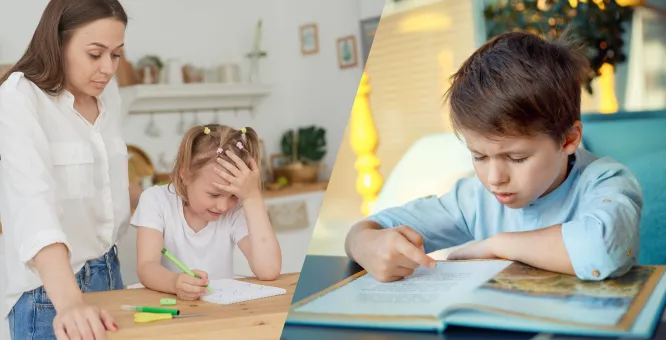
“They seem to be just guessing the words based on the pictures…”
“They know what the word means when they hear it, but can’t spell it correctly when they try to write it…”
Have you ever felt this frustration while watching your child read or study?
In fact, this may have less to do with a lack of effort and more to do with the limitations of an approach that skips decoding and encourages children to rely on pictures, context, or guesswork when reading.
While guessing might work in the early grades, this reading strategy quickly falls apart as they move up in grade level and encounter books without illustrations. Without a solid understanding of the relationship between sounds and letters, children cannot independently decode the vast vocabulary they already know by ear.
This is where the principles of the “Science of Reading” (SoR) have become foundational to modern reading instruction.
Why does reading based primarily on guessing eventually hit a wall? And how can we turn words they already know from listening to words they can read on their own? Here, we’ll explore practical steps that help children connect sounds and letters accurately— without a parent needing to sit beside them every step of the way.
1. Why Does the “Guessing Strategy” Hit a Wall Around 3rd Grade?
Books for Kindergarten through 2nd grade often feature illustrations that help children understand what is happening in the story. As a result, some children may come to rely on the pictures, the overall context, or words they have memorized rather than actually decoding the letters.
But around 3rd grade, as illustrations become less prominent and they transition to text-heavy chapter books, many start to encounter a new reading challenge.
When children have not yet fully developed their understanding of sound-letter correspondences and have become accustomed to relying on visual clues or intuition, they may face several obstacles as texts become more complex:
- Unable to read without pictures: Without visual clues, they may have difficulty decoding words using the letters alone, making it harder to follow the story.
- Struggling with longer words: As multi-syllabic words become more common, it becomes harder to recognize them based simply on their visual appearance or intuition.
- Getting stuck on unfamiliar words: Without a solid understanding of sound-letter correspondences, they may not know how to sound out and decode a word they have never seen before.
This is precisely why the Science of Reading (SoR) is now the foundation of modern reading instruction.
SoR demonstrates that instead of relying on guessing or visual memory, explicitly teaching the “rules of sounds and letters” in a systematic order is the most reliable way to raise an “Independent Reader”—a child who can correctly decode any text.
2. Three Ways Smile Zemi Brings SoR to Life with a Dedicated Tablet
Simply tapping multiple-choice answers on a screen does not provide the full benefits of a multisensory learning experience. Smile Zemi brings the multisensory approach emphasized by the SoR to life through the unique experience of using a dedicated device: seeing, hearing, and writing with a stylus.
1. Explicit Instruction | Animated Explanations (Learn)
We never ask children to guess how to read or infer the rules on their own. First, animated explanations and audio clearly introduce the sound-letter patterns taught in each lesson (e.g., silent ‘e’ or vowel teams) using clear animations and audio (Learn). Because they thoroughly understand the rule before moving on to the exercises (Practice), they develop the applied skills to decode even unfamiliar words using the rules they just learned.
2. Multisensory Approach | Handwriting Exercises with a Dedicated Stylus
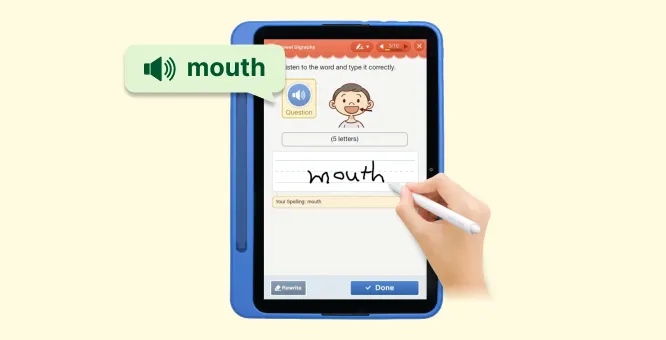
Simply tapping letters on a screen does not fully engage the process of connecting the sounds they hear with the letters they see and write—also known as letter-sound mapping. With Smile Zemi, children hear native English pronunciation and immediately write the corresponding letters using the dedicated stylus, creating an integrated hear-see-write experience similar to writing with pencil and paper. The multisensory approach helps strengthen the connection between sounds and written forms through orthographic mapping. They not only recognize a word when they see it, but also “spell it correctly when they hear it.” This builds lasting reading and spelling skills without relying solely on rote memorization.
3. In-text Vocabulary Support | Digital Glossary
As children move toward reading comprehension, building vocabulary directly within the context of a text is essential. If they encounter a difficult or unfamiliar word in a text, a simple tap brings up a pop-up showing the “audio pronunciation, part of speech, and English definition.” Instead of interrupting reading to look up a word in a separate dictionary, they can stay focused on the story and the structure of the text. Rather than relying on an uncertain guess based solely on context, they can instantly check the correct definition and pronunciation. This helps prevent misunderstandings and keeps reading moving.
3. Going Beyond “Tapping and Typing”: The Smile Zemi Approach
Even with the widespread adoption of SoR principles, many digital learning experiences still rely heavily on tapping on screen or typing responses. But when it comes to building a strong connection between sounds and letters, there is value in going beyond simply selecting on a screen. A more direct-sensory approach, such as writing letters by hand can help reinforce that connection.
| Feature | Smile Zemi ELA / Word Study | Tapping/Typing Practice |
|---|---|---|
| Learning Approach | Systematic lessons that teach letter-sound rules step-by-step. | Selecting words on a screen and receiving right/wrong feedback |
| Output (Answering) | Handwriting with a dedicated stylus | Tapping choices or typing. |
| Learning Process | Multisensory learning combining “hearing, seeing, and writing.” | Primarily relies on visual and motor repetition. |
| Reading Application | Can break down unfamiliar words using rules to decode independently (Independent Reader). | Can only read words they have memorized. |
| Progression to Upper Grades | Progresses from letter-sound rules to understanding morphology (roots and affixes), enabling decoding of complex, unfamiliar words based on structure. | Relies on memorization; struggles as words become more complex. |
4. Conclusion: When Sounds and Letters Connect, Reading Opens Up New Possibilities
If your child is struggling to progress in their reading or studies, what they need is not simply more guessing or memorization. They need a clear understanding of the rules that connect sounds and letters.
Smile Zemi combines a systematic curriculum grounded in the principles of the Science of Reading with the multisensory experience made possible by its dedicated tablet—seeing, hearing, and writing.
The words they know from listening become words they can read and write on their own. Why not start a new learning journey with Smile Zemi, so your child can experience the joy of reading independently?
